Protocell Communication Through the Eyes of Synthetic Organic Chemists

Our Concept Article was just published in EurJOC. The article discusses the concept of protocell communication from the point of view of organic chemists. First, it analyses the chemistry at the heart of the protocell communication machineries currently employed, and then it proposed new routes towards protocell communication based on fully synthetic and artificial nanosystems (synzymes). The work was funded by the European Union (ERC StG, PROTOMAT, 101039578).

Shining Light on Carbon Dots: New Opportunities in Photocatalysis

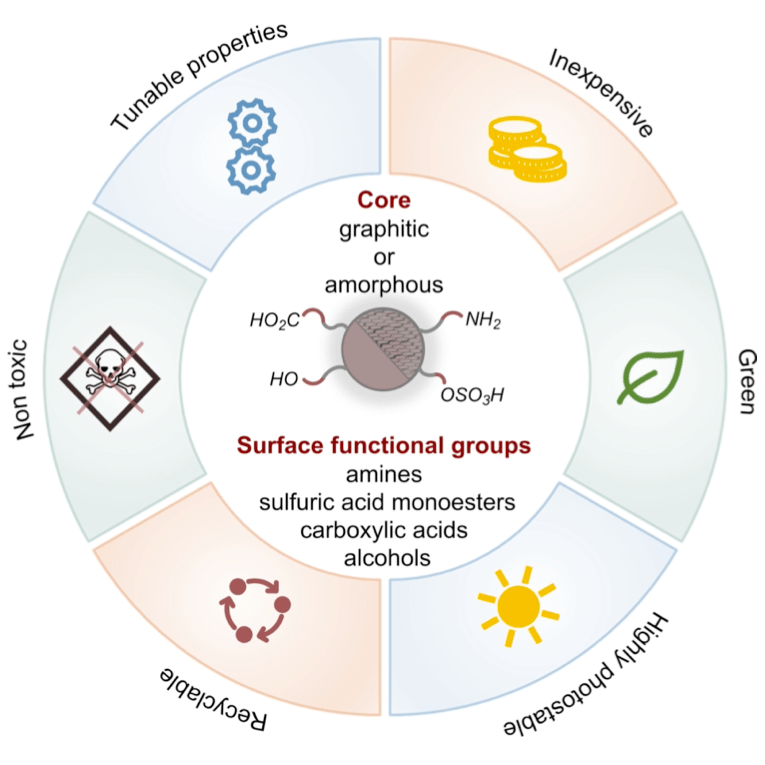
Our ChemCatChem Concept Article is now published. The article discusses recent advancements in carbon dots-based photocatalysis. We highlight the link between the carbon dots superficial and core composition and their resulting photo-redox abilities. We then give future perspectives on their application in cutting-edge areas. The work was carried out in collaboration with Dr. Giacomo Filippini and Prof. Maurizio Prato at the University of Trieste.

Colloidosomes as a Protocell Model: Engineering Life-Like Behaviour through Organic Chemistry

Colloidosomes are robust, versatile microcapsules that have emerged as promising candidates for protocell models. Read our just published review that highlights the role of organic chemistry in the engineering of colloidosomes with life-like behaviours, such as selective membrane permeability, adhesion, chemical signalling, dynamic multi-compartmentalisation, replication, and predation.

Automated Analysis of Soft Material Microindentation

Our RSC Soft Matter article is now published. The work describes the validation of a new method for the automated analysis of thousands of indentation curves for the 3D mapping of the mechanical properties of soft materials. The work was carried out in collaboration with Dr. Sebastien Rochat and Prof. Richard Trask at the University of Bristol, and funded by the EU Marie Curie Actions and the UK's EPSRC.