
Polymeric nanoparticles are among the most promising platforms in nanomedicine and advanced materials, yet achieving precise control over their surface chemistry and functionality remains a major challenge. This study explores how molecular-level engineering can be used to create highly versatile polymeric nanostructures with predictable properties and reactivity.
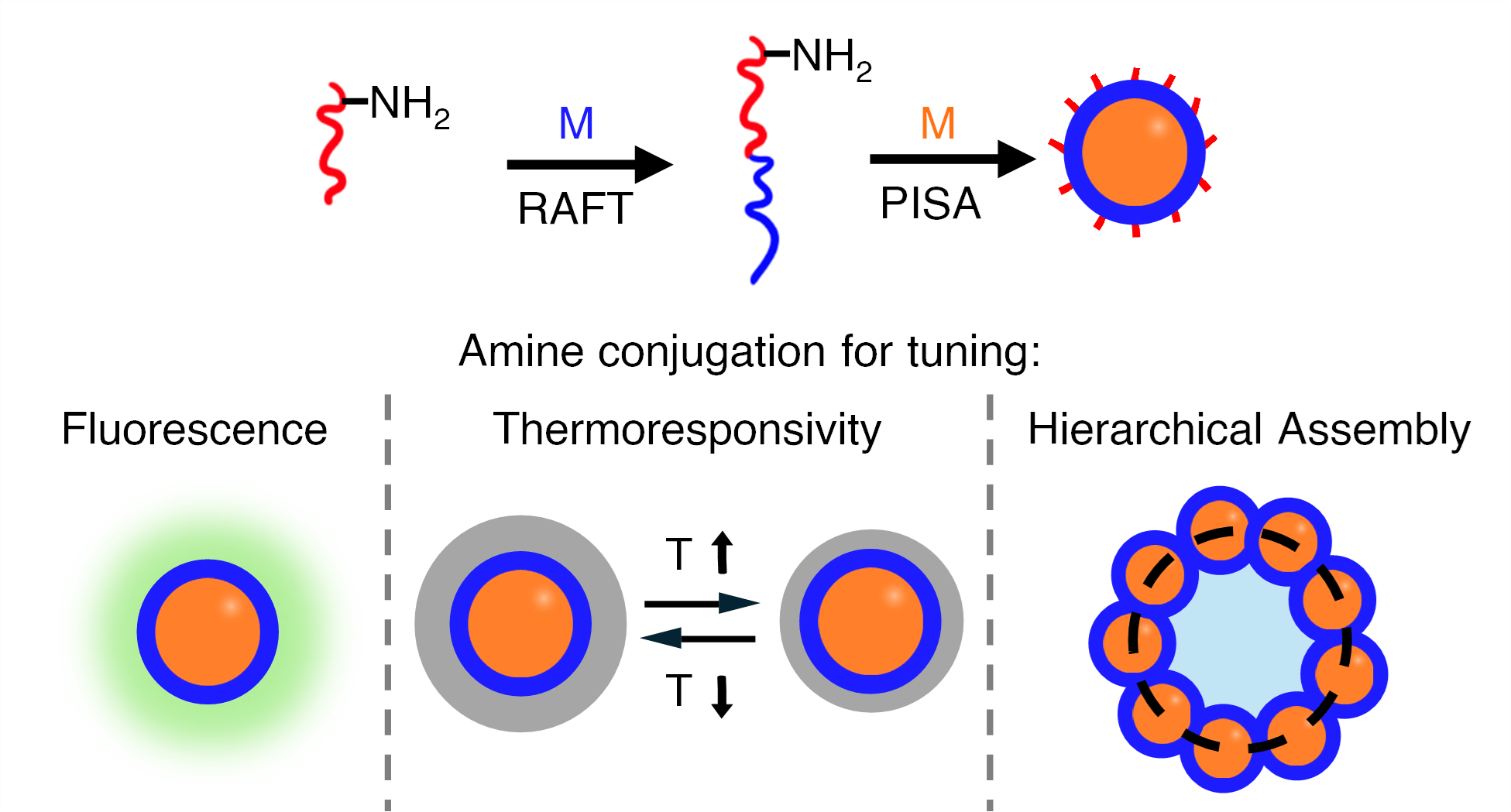
Our latest work presents the synthesis of amine-functionalized block copolymer nanoparticles through aqueous polymerization-induced self-assembly (PISA), combining synthetic scalability with rigorous structural control. The research was supported by the PRIN 2022 SAMBA project (2022285HC5_002), the European Research Council (ERC Starting Grant PROTOMAT – 101039578), the PRIN PNRR project 3D-LINKED (P2022BLNCS), and the PNRR project “Centro Nazionale di Ricerca – Sviluppo di Terapia Genica e Farmaci con Tecnologia a RNA” (CN00000041), all financed by the European Union Next Generation EU.
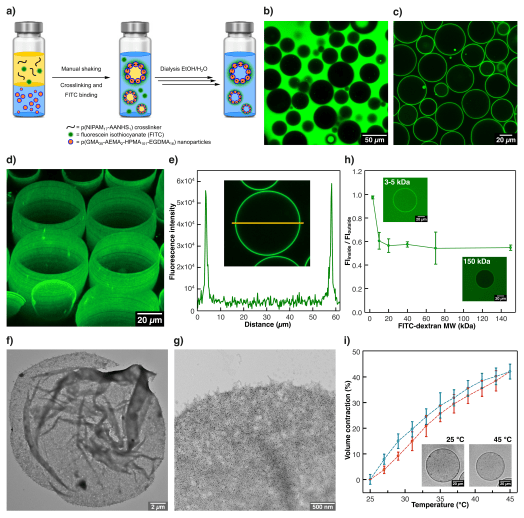
By incorporating reactive amine groups directly into the nanoparticle corona, we generated stable and monodisperse nanomaterials whose interfacial chemistry could be quantitatively tuned and exploited for post-assembly functionalization. To demonstrate the versatility of the platform, the nanoparticles were efficiently conjugated with fluorescein isothiocyanate and with thermoresponsive poly(N-isopropylacrylamide), achieving near-quantitative functionalization efficiencies. In the latter case, the resulting hybrid nanoparticles exhibited a controllable lower critical solution temperature transition at 41 °C, highlighting the possibility of engineering responsive nanosystems with finely adjustable behaviour.
Beyond single-particle functionalization, the nanoparticles could also self-assemble into crosslinked colloidosomes, demonstrating their potential as modular building blocks for the fabrication of higher-order hierarchical architectures.
By integrating controlled polymer synthesis, quantitative surface functionalization, and hierarchical self-assembly, this work establishes a robust framework for the rational engineering of polymeric nanomaterials, opening new opportunities in drug delivery, diagnostics, nanoreactor development, and adaptive materials.
Link to the article.

