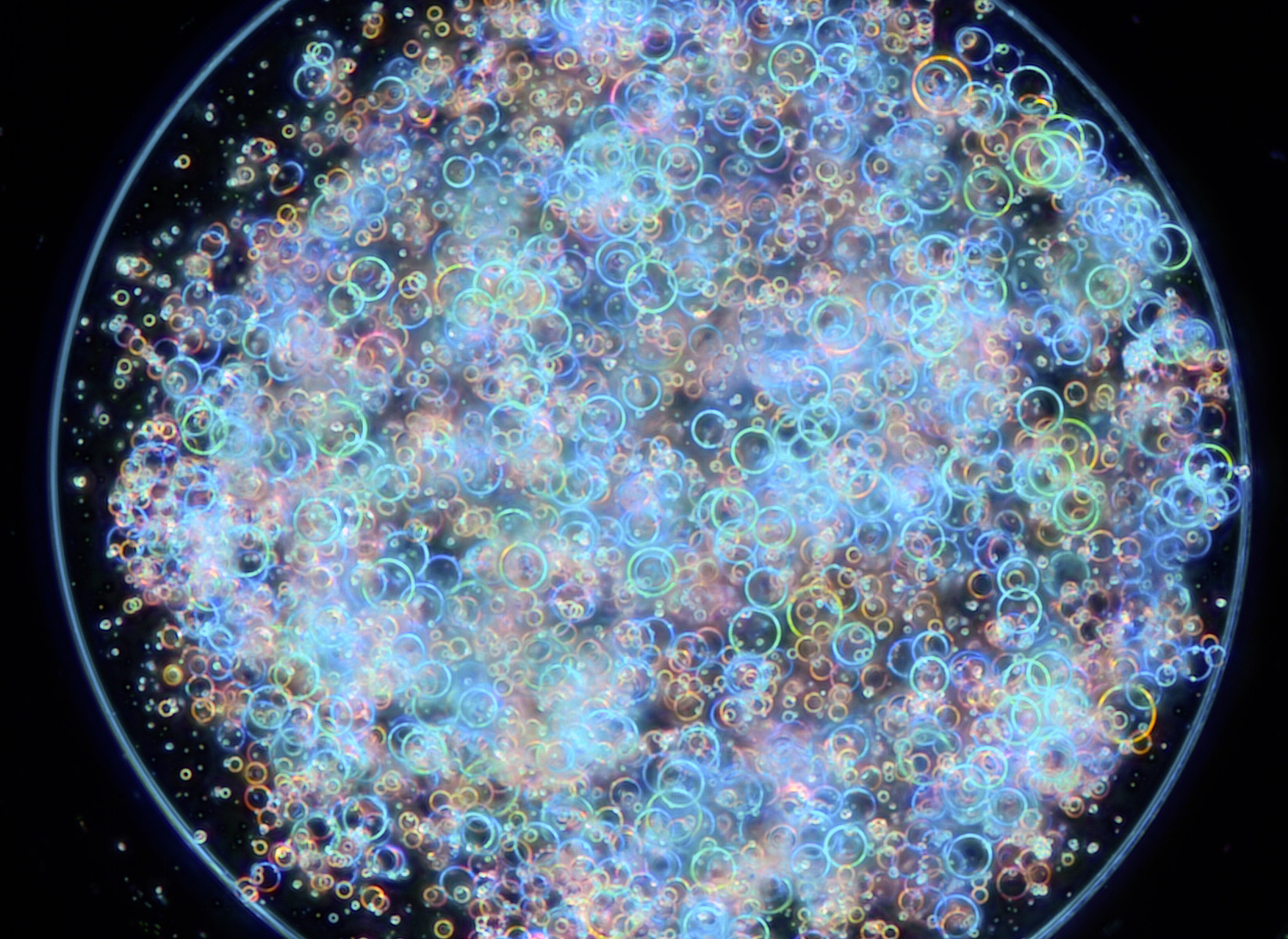
Our latest concept paper, published in Chemistry-A European Journal, introduces Coacervate Vesicles as a new class of protocells that combine the functionalities of complex coacervates with the robustness of membranised architectures. These novel artificial cells offer enhanced compartmentalisation and stability, opening up exciting possibilities in areas ranging from bio-inspired systems to drug delivery and synthetic …
A Photonastic Prototissue Capable of Photo-Mechano-Chemical Transduction
The Gobbo Group has created the first light-responsive artificial tissues-like materials, or photonastic prototissues, that can mimic natural energy transduction processes. Published in Advanced Materials, the work combines gold nanoparticle-based proto-organelles and a responsive polymer “proto-cortex” to build protocells that contract under visible light. These motions can reversibly control internal enzyme activity, offering a new way to engineer life-like behaviours. This advance marks a significant step towards advanced, energy-responsive prototissues in synthetic biology and bioinspired materials engineering.
Photochemical Patterning and Characterization of Mechanical Properties on Soft Materials
Innovative photoresponsive hydrogels have been developed, enabling advancements in soft robotics and digital information storage. Characterized through microindentation, the new photo-stiffening and photo-softening hydrogels utilize unique crosslinking methods. Their integration allows the design of soft actuators controlled by UV light, paving the way for versatile applications in multiple fields.
Matching Together Living Cells and Prototissues: Will There Be
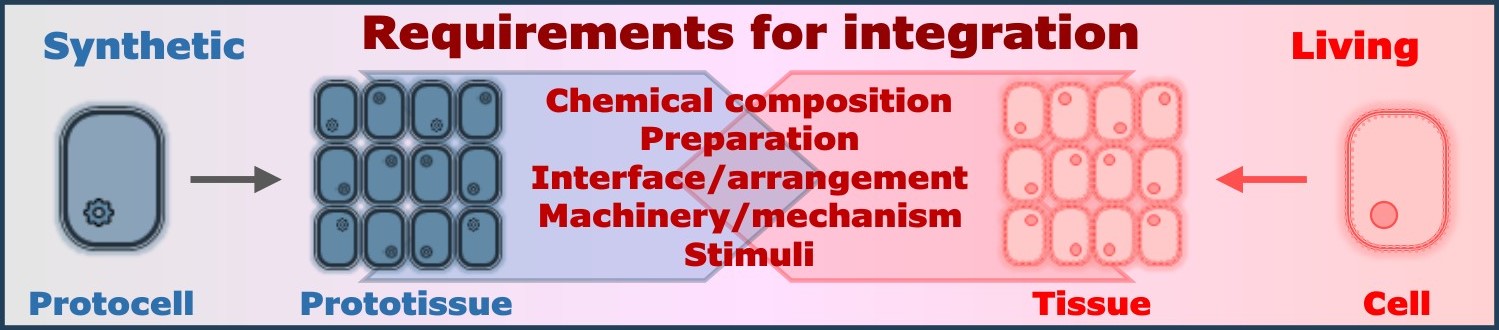
This review in ChemBioChem examines the interactions between synthetic cells, tissues, and living counterparts, aiming for full integration. It discusses advancements in synthetic/living cells interactions, prototissue engineering, and stimuli-driven tissue engineering, paving the way for future studies in tissue engineering, synthetic biology, and regenerative medicine. The work was funded by the European Union and Fondazione Istituto di Ricerca Pediatrica Città della Speranza.
Higher-order Behaviours in Bio-inspired Materials
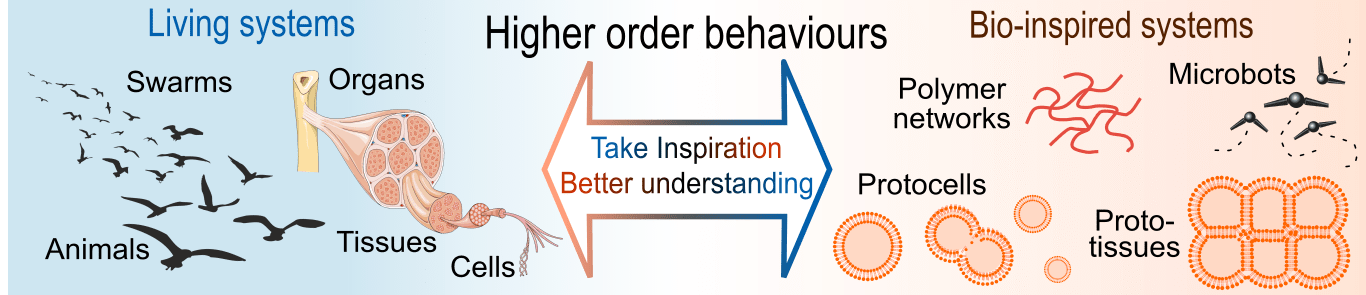
This mini-review, published in ChemSystemsChem, introduces the concept of higher-order behavior in materials chemistry, discussing the development of such behaviors in bio-inspired systems like polymer networks, microbots, protocells, and prototissues. It emphasizes the ability to chemically program these materials and their potential applications in various fields, from tissue engineering to regenerative medicine. The work was funded by the European Union (ERC StG, PROTOMAT, 101039578; Marie Curie Postdoctoral Fellowship, PROTO-BACT, 101107715).
PhD Scholarships in Chemistry available, start date November 2024!
We are seeking candidates with experience in chemical synthesis for a PhD scholarship in Chemistry. Funded by the EU Pathfinder Open project PLANT-ON, the scholarship aims to develop photosynthetic protocells for formic acid production. Applicants should contact Prof. Gobbo directly with a CV and motivation letter. Deadline: 7 June 2024.
A Photo-degradable Crosslinker for the Development of Light-responsive Protocell Membranes
Patrick's and Mary's PhD works are now published as a Chem. Eur. J. research article! In this work we developed a novel photo-degradable crosslinker and used it to fabricate protein-polymer microcapsules. We then showed that these protein-polymer microcapsules are capable of light-induced disassembly, could be used for the photo-generation of patterns of synthetic cells, and for the modulation of synthetic cell membrane permeability.
PhD Scholarships Available!
PhD Scholarships available in the Gobbo Group, start date 01 Nov 2023 - We are interviewing candidates.
Automated Analysis of Soft Material Microindentation
Our RSC Soft Matter article is now published. The work describes the validation of a new method for the automated analysis of thousands of indentation curves for the 3D mapping of the mechanical properties of soft materials. The work was carried out in collaboration with Dr. Sebastien Rochat and Prof. Richard Trask at the University of Bristol, and funded by the EU Marie Curie Actions and the UK's EPSRC.
Jean Golding Institute has funded our research on machine learning-assisted polymer design
Groundbreaking research programme on machine learning-assisted polymer design is taking off thanks to Jean Golding Institute £5k seed grant.