


Our latest concept paper, published in Chemistry-A European Journal, introduces Coacervate Vesicles as a new class of protocells that combine the functionalities of complex coacervates with the robustness of membranised architectures. These novel artificial cells offer enhanced compartmentalisation and stability, opening up exciting possibilities in areas ranging from bio-inspired systems to drug delivery and synthetic biology.
The work was funded by the National Recovery and Resilience Plan (project P2022BLNCS – 3D-L-INKED, project 2022285HC5_002 – SAMBA, project PNRR “Centro Nazionale di Ricerca – Sviluppo di Terapia Genica e Farmaci con Tecnologia a RNA” Spoke n. 4 “Metabolic and cardiovascular diseases”, CN00000041), and the European Union (ERC StG, PROTOMAT, 101039578).
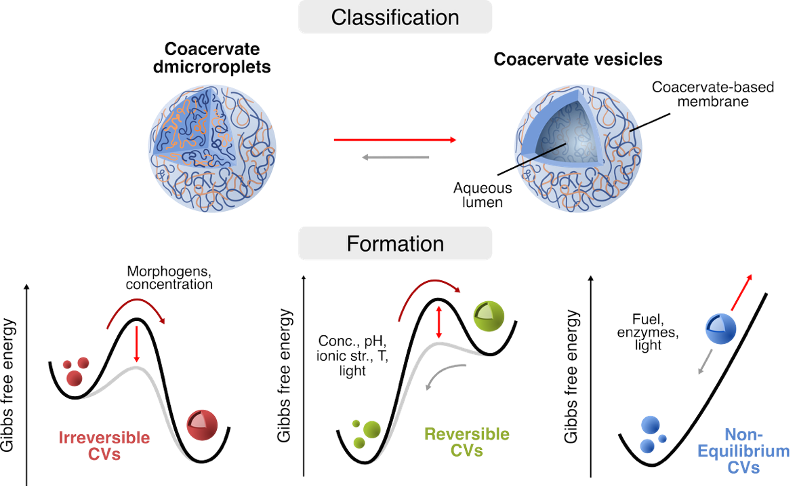
The article provides a first classification of Coacervate Vesicles, reviewing recent advances in their fabrication and applications, and highlighting their potential as a versatile platform for future research. The paper further explores how these unique properties translate into promising applications. These include the creation of artificial life-like systems capable of mimicking biological processes, the development of complex and responsive communication networks, and the engineering of adaptive soft materials. While the field is still emerging, the simplicity, programmability, and robustness of these structures position them as a powerful foundational technology for the future of synthetic biology and bio-inspired engineering.
Full article available here.
 The Gobbo Group