

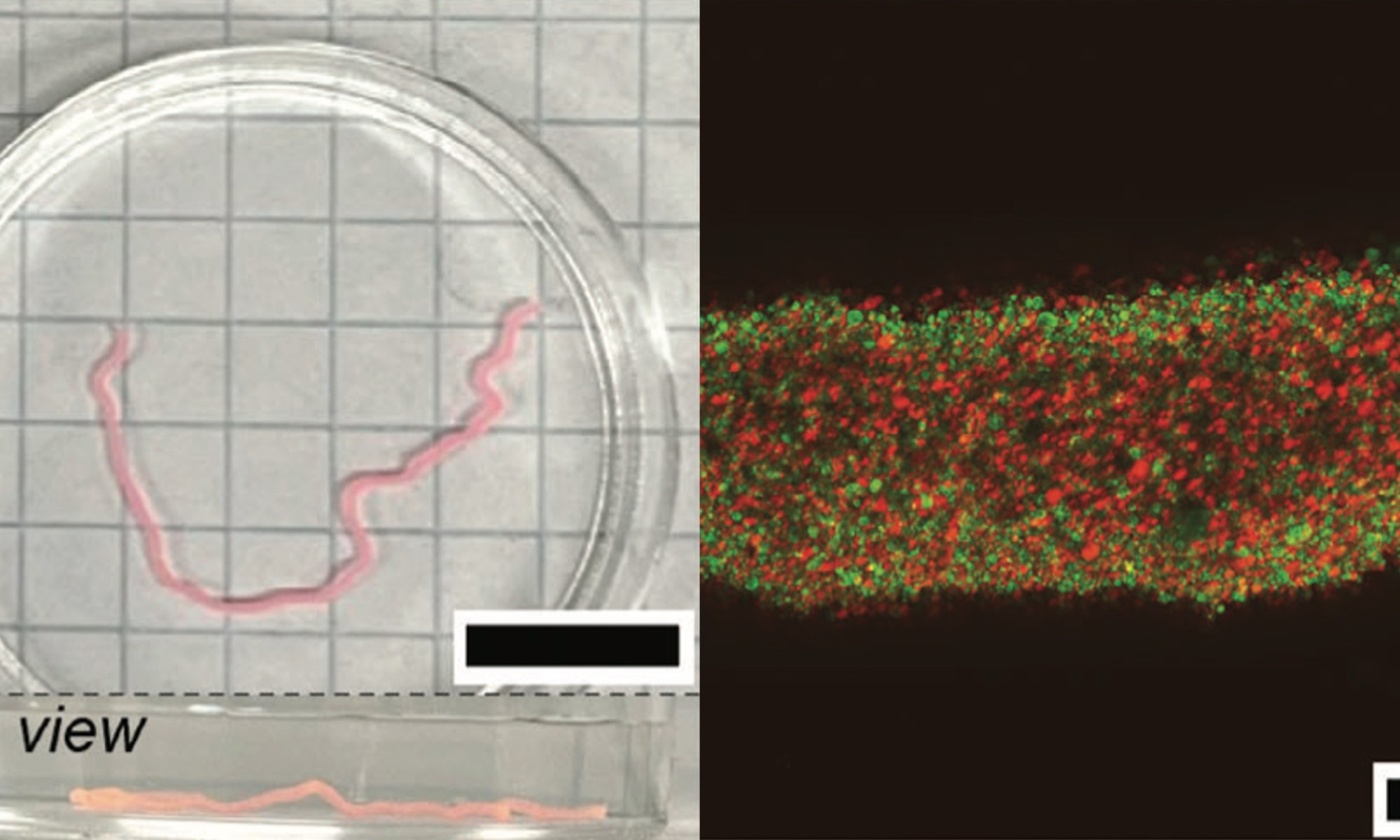
Our research team has made an exciting breakthrough in creating artificial tissue-like structures. Taking inspiration from nature, where cells work together to form complex tissues in living organisms, we have developed a groundbreaking method to create what we call “prototissue fibers.”
This work, published in Advanced Science, was carried out in collaboration with the research group of Prof. Taisuke Banno at Keio University (Japan); it was a pleasure to host PhD student Tomoya Kojima in Trieste!
The work was funded by Japan Society for the Promotion of Science (KAKENHI Grant Nos. JP20H02712 and JP22KJ2723), the European Research Council (Starting Grant 101039578 – PROTOMAT), and the European Union Next Generation EU (project PRIN PNRR 3D-L- INKED – P2022BLNCS).
So, how do you build a material that acts like living tissue? The answer lies in vesicles—microscopic bubbles with membranes similar to human cells. We mixed two types of vesicles (one positively charged, one negatively charged) and used salt bridges—a natural molecular “glue”—to stick them together. Think of it like LEGO blocks snapping into place, but at the tiniest scale!

One of our key innovations is the ability to incorporate different specialized modules into these fibers. For instance, we demonstrated that we could add sections that respond to magnetic fields, making the fibers directionally controllable. We also created modules that work together to detect chemical signals and respond by producing fluorescent light through a cascade of enzymatic reactions.
What makes our work particularly significant is that these fibers could serve as fundamental building blocks for creating new types of soft materials with customizable architectures and distributed functionalities. This represents a major step forward in the field of prototissue engineering.
Our research opens up exciting possibilities in several fields such as 3D bioprinting applications, advanced tissue engineering, and development of innovative soft robotics
We believe this work addresses a crucial challenge in the field of prototissue engineering and sets the stage for developing next-generation bioinspired materials that could revolutionize how we approach tissue engineering and soft robotics.
Link to the article.
 The Gobbo Group