

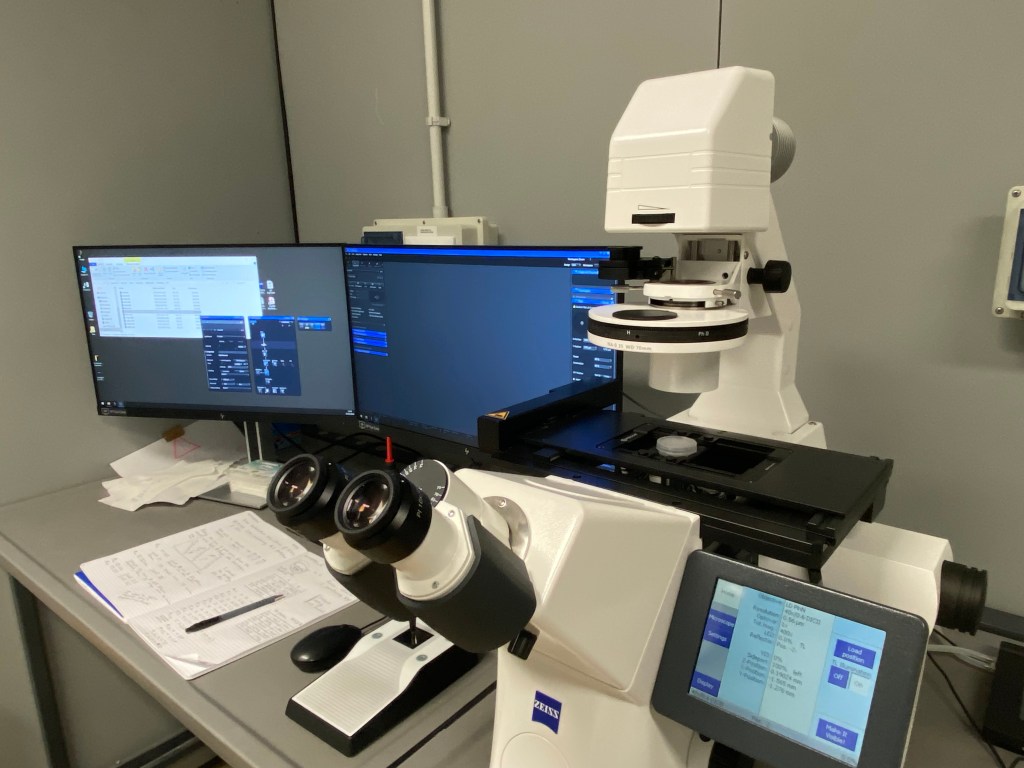
Axio Observer 7 inverted microscope (Zeiss) equipped with a CMOS camera Orca Flash 4.0 v3 (Hamamatsu). The instrument includes a motorised sample stage for multi-area mosaic image acquisition. Brightfield images are acquired using an LED transmitted light illuminator. Fluorescence images are acquired using a 120 W metal halide lamp illuminator (HXP120, Zeiss) by selecting the excitation and emission channels with different filters/dichroic mirror sets, as follows: blue channel (Dylight405) λexc = 365/12 nm, dichroic mirror = 395 nm, λem > 397 nm; green channel (FITC) λexc = 470/40 nm, dichroic mirror = 495 nm, λem = 525/50 nm; red channel (RITC) λexc = 546/12 nm, dichroic mirror= 560 nm, λem = 575-640 nm.
The microscope is quipped with the following objective lenses:
– EC Plan Neofluar 2.5x/0.085 NA (Zeiss)
– EC Plan-Neofluar 10x/0.3 NA Ph1 (Zeiss)
– LD Plan-Neofluar 20x/0.4 NA (Zeiss)
– LD Plan-Neofluar 40x/0.6 NA (Zeiss)
– Oil immersion Plan-Apochromat 63x/1.4 NA (Zeiss).
The microscope is also equipped with an Apotome 3® optical sectioning system that significantly increases the axial resolution and contrast of images compared to conventional fluorescence widefield microscopy. It allows for the acquisition of optical sections, even from thick specimens, that can be rendered in 3D with the Apotome package included in the Zen software (Zeiss).
Finally, the instrument can be used to carry out controlled temperature experiments using a sample holder with an incubator chamber (Pecon).
 The Gobbo Group