
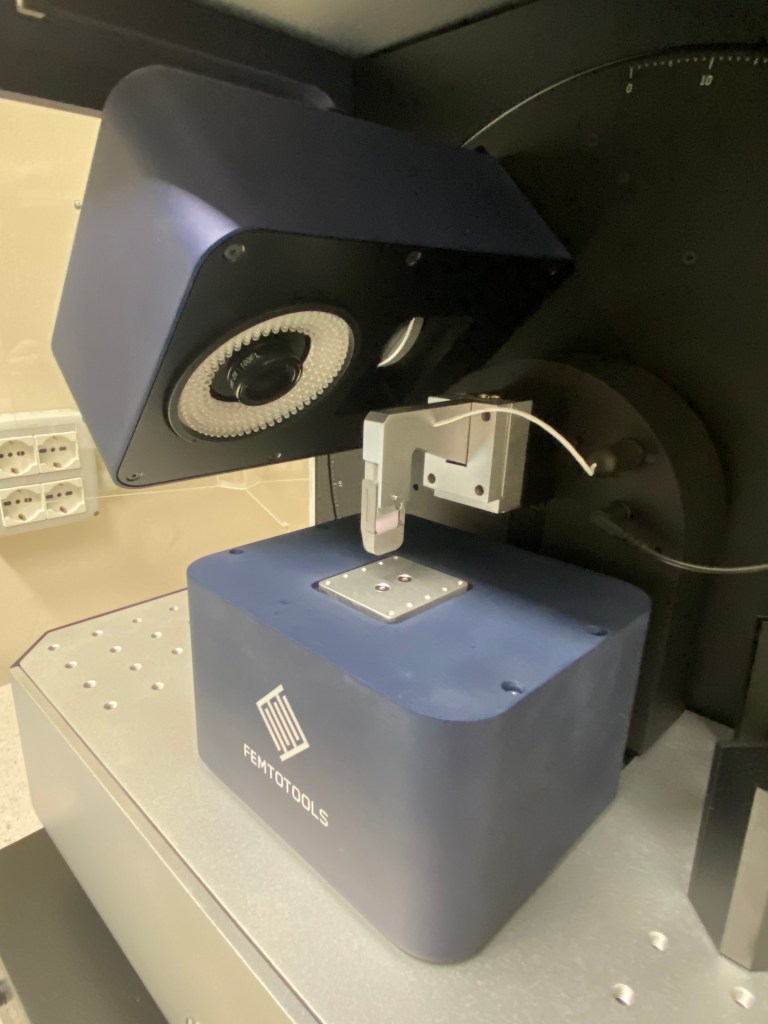
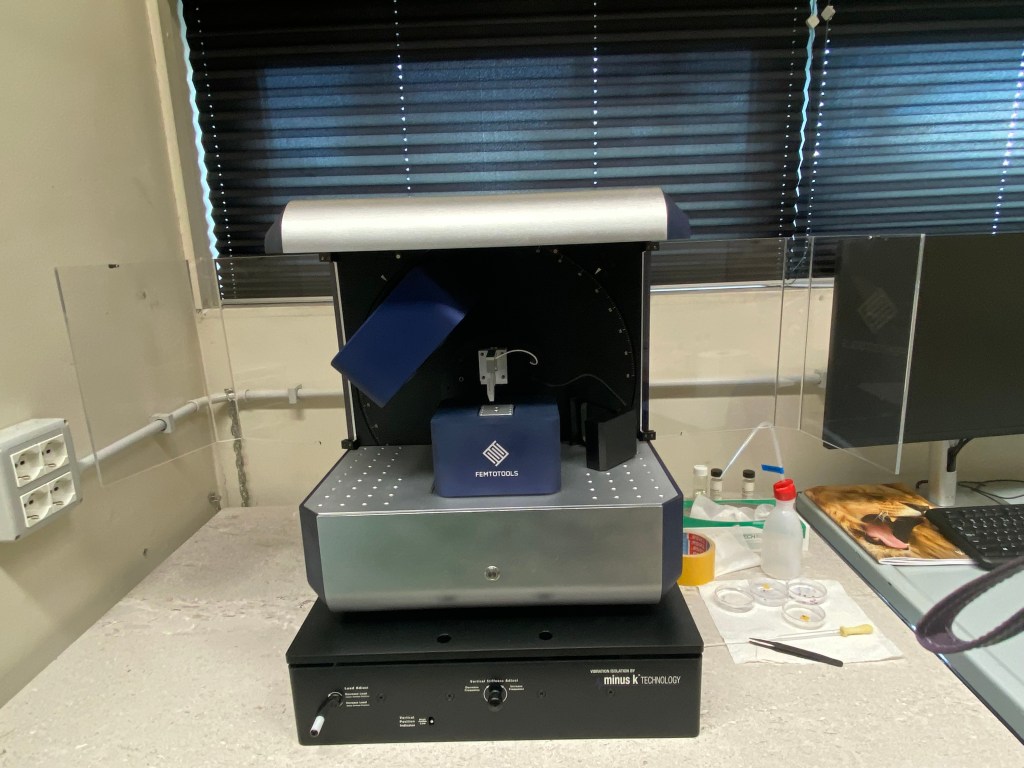
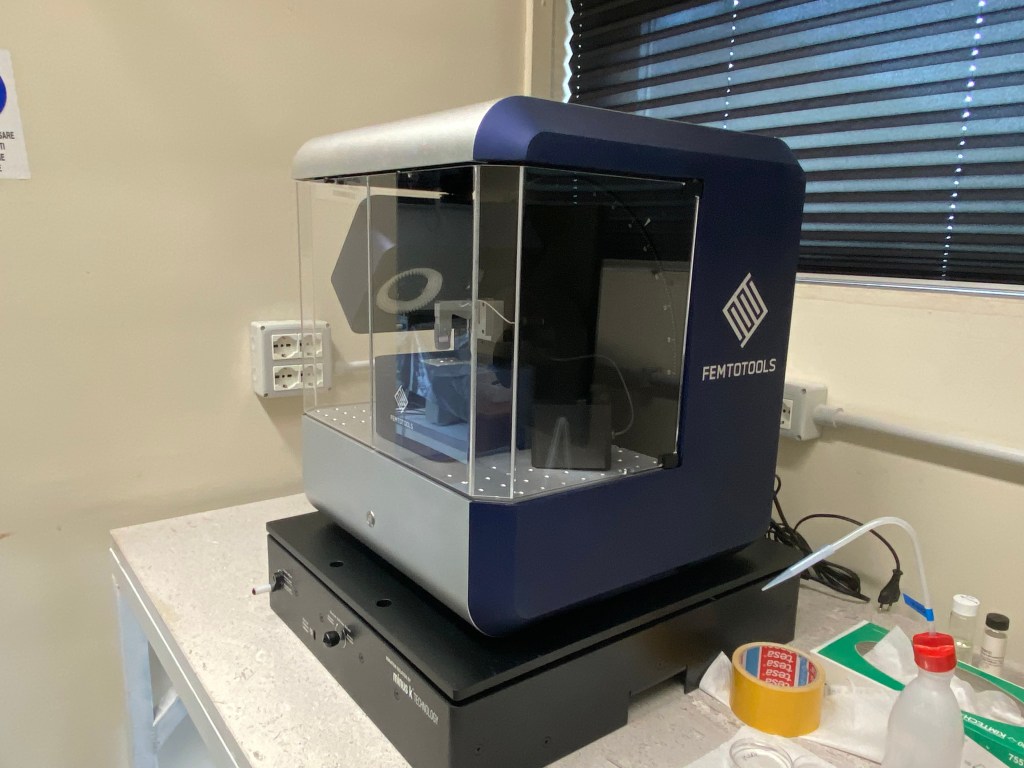
FT-MTA03 ‘‘Micromechanical Testing and Assembly System’’ from Femto-Tools AG (https://www.femtotools.com/products/ft-mta03/description).
The instrument is equipped with a MEMS-based FT-S Microforce Sensing Probe with a force range of ± 2000 μN at a resolution of 0.005 μN. However, Femto-Tools AG provides other probes for covering the full range from ± 200 μN up to ± 200,000 μN. The testing module includes 3-axis nanopositioning (stick-slip actuation): from 20 nm to 29 mm with a position resolution of 1 nm, and 3-axis piezoscanner: from 0.1 nm to 50 μm with a position resolution of 0.1 nm. The positioning is computer controlled.
The instrument also features a digital microscope module to observe the details of the probe indenting the sample. The microscope includes a 2-axis positioning stage (10 mm x 40 mm) and can be tilted over a range of 180° around the sample and probe. It has a high working distance of 95 mm and a large depth of field that can be adjusted by an iris. The microscope is equipped with a USB 3 camera (2048 x 1536 pixel CMOS). The microscope also features a 7:1 motorized optical zoom and motorized focus (25 mm). Moreover, three different adjustable LED illumination modes can be selected:
– Coaxial through-the-lens illumination
– Ring-light
– Diffuse backlight
The software suite allows several types of testing configurations for performing compression, stress relaxation and frequency sweep experiments, from which the main mechanical features of the investigated materials can be retrieved.
Our indentation probes feature a borosilicate glass sphere (50 or 300 µm in diameter) attached to the tip with a UV-curable adhesive. This specific spherical geometry allows experimental indentation curves to be accurately fitted to established theoretical models, enabling the reliable extraction of sample mechanical properties.
The entire instrument is housed within a thermostated box, facilitating indentation measurements at controlled temperatures ranging from room temperature to 50°C.
Data analysis and the mapping of mechanical properties are performed using our in-house developed software ALIAS (A Lovely Indentation Analysis System). This software automatically processes thousands of indentation curves to extract all mechanical parameters from the sample. It also generates 3D maps to visualize spatial patterns in the sample’s mechanical properties.
Relevant publications:
1) H. E. Symons, A. Galanti, J. C. Surmon, R. S. Trask, S. Rochat, P. Gobbo*, “Automated Analysis of Soft Material Microindentation”. Soft Matter, 2022, 18, 8302–8314. (Article, ESI)
2) J. H. Park, P. J. Grimes, H. E. Symons, N. Braidotti, S. Rochat,* M. S. Workentin,* P. Gobbo*, “Photochemical patterning and characterization of mechanical properties on soft materials”. Adv. Funct. Mater., 2025, 35, 2416095. (Article, ESI)
3) A. Galanti†, B. Rosetti†, S. Valente, N. Braidotti, M. Sbacchi, S. Todros, P. Pavan, P. Gobbo*, “A photonastic prototissue capable of photo-mechano-chemical transduction”. Adv. Mater. 2025, 2502830. (Article, ESI)
 The Gobbo Group