

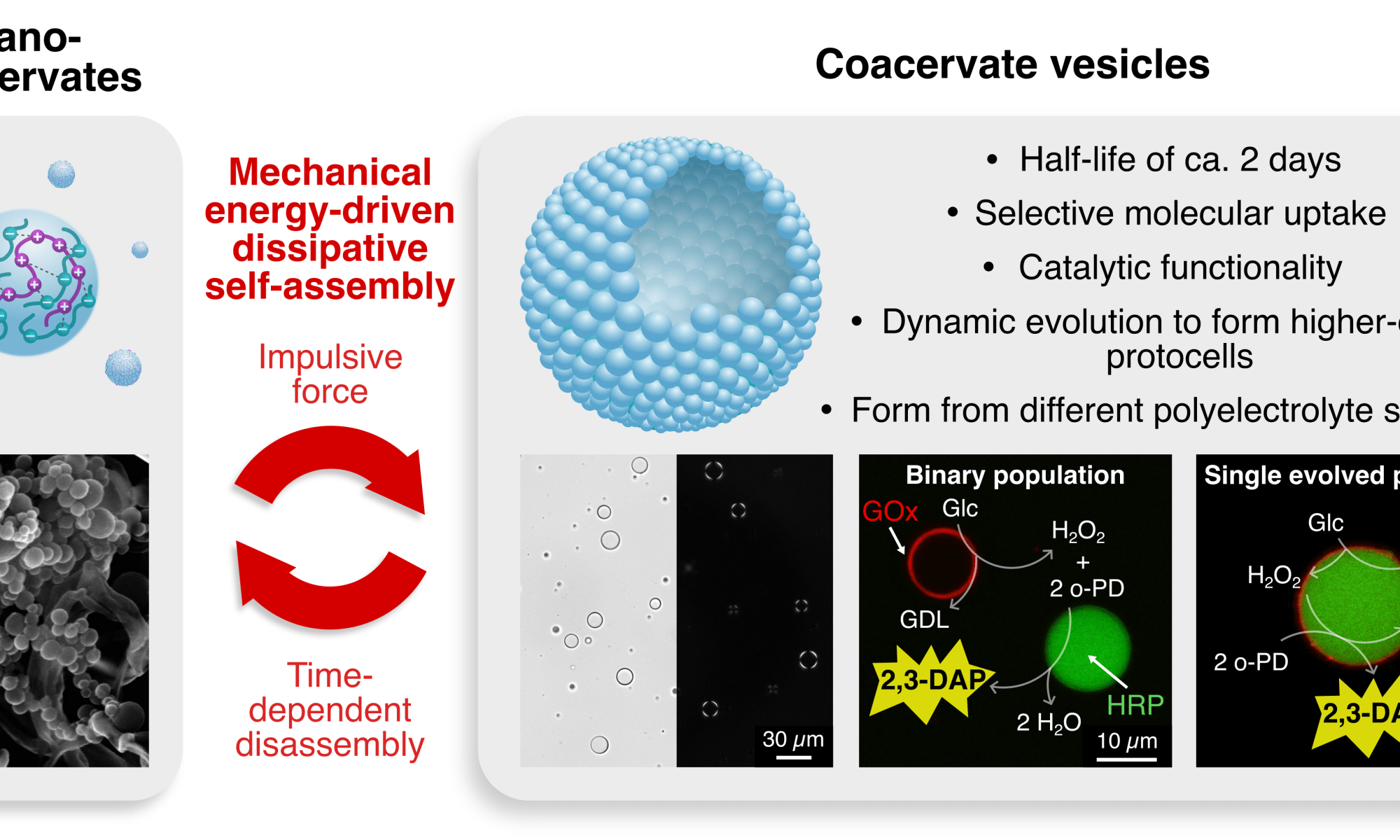
The group’s latest work demonstrates that dissipative, self-assembled micrometrical protocells can be formed from nanoscale precursors using mechanical energy alone as the driving force.
The study, recently published in the Journal of the American Chemical Society, represents part of Francesco Vicentini’s PhD project and was developed in collaboration with Prof. W. H. Briscoe (School of Chemistry, University of Bristol) and M. Conti and S. Dal Zilio (CNR – Istituto Officina dei Materiali, Trieste).
The research was supported by the European Union ERC (PROTOMAT, 101039578), the European Union EIC project (PLANKT-ON, 101099192), the project PRIN PNRR 3D-L-INKED (P2022BLNCS), the project PRIN PNRR SAMBA (2022285HC5_002), and the project PNRR Centro Nazionale di Ricerca-Sviluppo di Terapia Genica e Farmaci con Tecnologia a RNA Spoke n. Four “Metabolic and cardiovascular diseases” (CN00000041).
This pioneering work introduces mechanical energy as a novel driver of dissipative self-assembly, enabling the formation of coacervate vesicles with a half-life of approximately two days and exhibiting key cell-like properties such as selective molecular uptake and catalytic functionality. A particularly striking aspect of this approach is its simplicity: manual shaking alone is sufficient to transform previously overlooked polymeric nanocoacervate precursors into discrete, microcompartmentalized vesicles that revert back to the nanocoacervate state in the absence of mechanical energy.
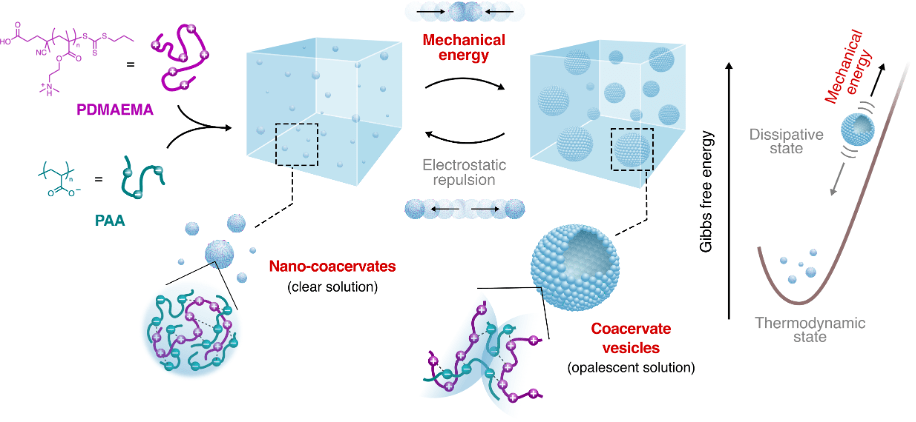
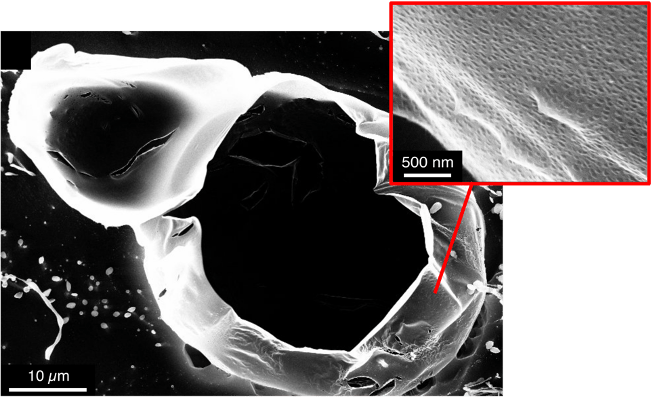
The study reveals how nanocoacervates form complex interactions during vesicle membrane formation under mechanical stimulation. As a dissipative system, the vesicles gradually disassemble once the mechanical energy input ceases; however, they can be reassembled multiple times upon new mechanical activation. Importantly, this strategy is generalizable across different polyelectrolyte systems, including DNA- and peptide-based combinations, suggesting potential relevance to natural systems and origin-of-life scenarios.
Finally, the work demonstrates that mechanical energy can drive the evolution of distinct dissipative protocell populations into a single, higher-order population, characterized by advanced compartmentalization and enhanced synthetic capabilities. Overall, this study establishes mechanical energy as a key and previously underexplored driver of dissipative self-assembly, with broad implications for life-like materials engineering, biotechnology, and microreactor design.
Full article available here.
 The Gobbo Group