
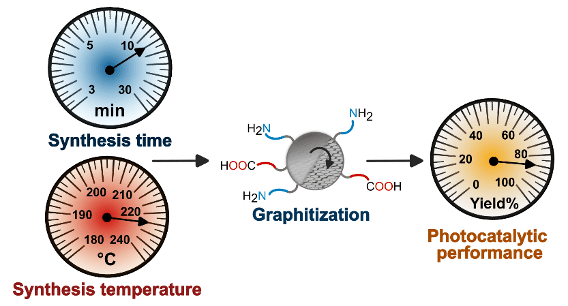
Photocatalysis is a growing field of chemistry in which carbon dots (CDs) have attracted considerable interest as an environmentally friendly alternative to conventional photocatalysts. This article demonstrates that by adjusting their synthesis time and temperature, it is possible to tune the degree of graphitization of their core. This was found to have an important effect on CD photocatalytic properties, proving that by tuning the synthesis it is possible to tune the properties of the final materials.
This work now published in ACS Nano was carried out in collaboration with Prof. Maurizio Prato, Prof. Giacomo Filippini (University of Trieste, Italy), Dr. Lucia Cardo, and Dr. Elisa Sturabotti (CIC BiomaGUNE, Spain). It was funded by the European Research Council (ERC AdG-2019 n° 885323, e-DOTS; PROTOMAT – 101039578), University of Trieste, INSTM, Italian Ministry of Education MIUR (cofin Prot. 2017PBXPN4 and Prot. 20228YFRNL) and by Region FVG Microgrants 2024 (LR 2/2011, ART. 4).
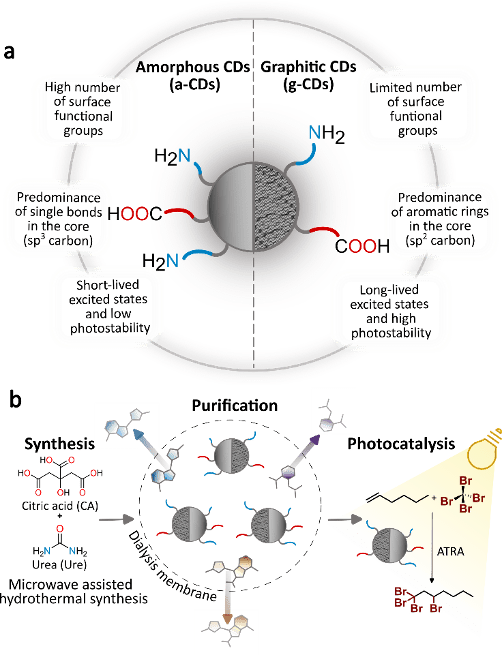
The chemical structure and photoredox properties of carbon dots (CDs) are not yet fully understood. However, it has been reported, that by carefully choosing the starting materials and tuning their synthesis conditions, it is possible to obtain CDs with different chemical structures and therefore different photocatalytic performance. In this work we showed that highly graphitized CDs exhibit superior catalytic performance due to the presence of (hetero)aromatic systems in their cores, which facilitate electron transfer during photocatalytic reactions. Additionally, CDs with a robust graphitic core show resistance to photobleaching and are recyclable over multiple catalytic cycles. This will benefit the engineering of a new generation of inexpensive photocatalysts, thus ensuring the possibility of expanding their application to synthetic, industrial and naturally relevant photochemical transformations.
Link to the article.
 The Gobbo Group